
Jonas Pirkl is a Research Associate at Fraunhofer IIS in Nuremberg, where he pursues his Ph.D. researching the application of machine learning to RF systems for localization and sensing. He started his career through a dual study program (2017-2022) at Sopra Financial Technology GmbH, earning a Computer Science Expert certification in System Integration and a B.Sc. in Computer Science from Technische Hochschule Nürnberg Georg Simon Ohm While completing his Master’s degree (2022-2024), he worked at Sopra Financial Technology, progressing to Senior Software Engineer with a focus on SAP and HubSpot CRM systems. He completed his master’s thesis on “Self-Supervised Pretraining of Transformers for Channel Parameter Estimation of Radio Frequency Signals,” with honors in cooperation with Fraunhofer IIS , which led to his current research position.
Research Interests:
- RF Localization
- Self-Supervised Learning
- Channel Charting
Publications

Passive Channel Charting: Locating Passive Targets using a UWB Mesh
Fingerprint-based passive localization enables high localization accuracy using low-cost UWB IoT radio sensors. However, fingerprinting demands extensive effort for data acquisition. The concept of channel charting reduces this effort by modeling and projecting the manifold of channel state information (CSI) onto a 2D coordinate space. So far, researchers have only applied this concept to active radio localization, where a mobile device intentionally and actively emits a specific signal.In this paper, we apply channel charting to passive localization. We use a pedestrian dead reckoning (PDR) system to estimate a target’s velocity and derive a distance matrix from it. We then use this matrix to learn a distance-preserving embedding in 2D space, which serves as a fingerprinting model. In our experiments, we deploy six nodes in a fully connected ultra-wideband (UWB) mesh network to show that our method achieves high localization accuracy, with an average error of just 0.24 m, even when we train and test on different targets.
Resilient Channel Charting Under Varying Radio Link Availability
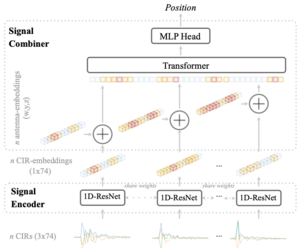
We show a channel charting architecture that can natively handle variable numbers of CSI measurements and arbitrary antenna subsets. Across two public real-world SISO and MIMO datasets, AdaPos maintains state-of-the-art localization accuracy under missing-antenna conditions, replaces roughly 57 configuration-specific models with a single unified model, and provides resilience to both individual antenna failures and full-array outages.
Radio Foundation Models: Pre-training Transformers for 5G-based Indoor Localization
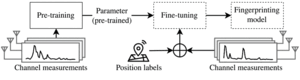
We propose a self-supervised learning framework that pre-trains a general transformer (TF) neural network on 5G channel measurements that we collect on-the-fly without expensive equipment. Our novel pretext task randomly masks and drops input information to learn to reconstruct it. So, it implicitly learns the spatiotemporal patterns and information of the propagation environment that enable FP-based localization. Most interestingly, when we optimize this pre-trained model for localization in a given environment, it achieves the accuracy of state-of-the-art methods but requires ten times less reference data and significantly reduces the time from training to operation.