
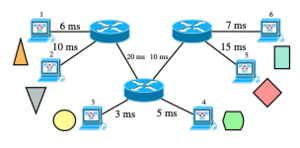
This paper presents a speculative processing technique for out-of-order event streams that enhances typical buffering approaches. We use a buffering technique to delay events but also speculatively processes a portion of it, and adapt the degree of speculation at runtime to fit the available system resources so that detection latency becomes minimal. This paper presents a safe runtime migration of stateful event detectors that respects low-latency time-constraints and seamlessly orders input events correctly on the migrated host. Event streams are only forwarded until timing delays are properly calibrated, the migrated event detector immediately stops processing after its state is transferred, and the processing overhead is negligible. On a Realtime Locating System (RTLS) we show that we can efficiently migrate event detectors at runtime between servers where other techniques would fail. The 2013 edition of the Grand Challenge focuses on real-time, event-based sports analytics. The 2013 Grand Challenge data set was collected during a football match carried out at a Nuremberg Stadium in Germany and is complemented with a set of continuous analytical queries which provide detailed insight into the match statistics for both team managers and spectators. We present a method, by which a domain expert can simply signal the occurrence of a significant incident at a specific point in time. The system then infers rules for automatically detecting such occurrences later on. At the core of our approach is an extension of hidden Markov models (HMM) called noise hidden Markov models (nHMM) that can be trained with existing, low-level event data. The nHMM can be applied online without any intervention of programming experts. An evaluation on both synthetic and real event data shows the efficiency of our approach even under the presence of highly frequent, insignificant events and uncertainty in the data. This paper proposes an online data mining method that is able to recognize repeating patterns of trajectory movements regardless of how they are scaled, rotated or translated. The result is an efficient data stream mining application, which provides meaningful information within the current game. The framework is designed in a modular manner in order to enhance the capabilities easily. The evaluation of the algorithms proves the efficiency of the provided concepts.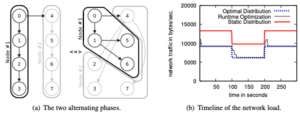
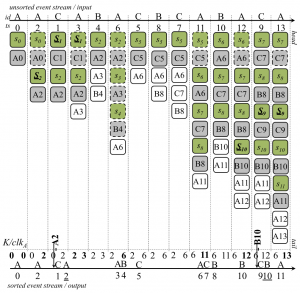
Reliable Speculative Processing of Out-of-Order Event Streams in Generic Publish/Subscribe Middlewares
Our technique outperforms known approaches on both synthetical data and real sensor data from a Realtime Locating System (RTLS) with several thousands of out-of-order sensor events per second. Speculative buffering exploits system resources and reduces latency by 40% on average.
Runtime Migration of Stateful Event Detectors with Low-Latency Ordering Constraints

The DEBS 2013 Grand Challenge
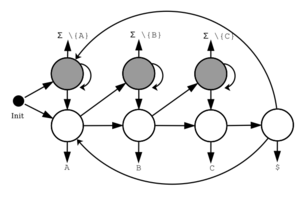
Learning Event Detection Rules with Noise Hidden Markov Models
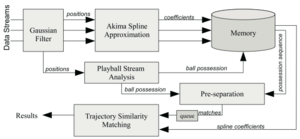
Online Data Stream Mining on Interactive Trajectories in Soccer Games
« First ‹ Previous 1 4 5 6