

Prof. Dr. Christopher Mutschler has been a Full Professor at the University of Technology Nuremberg (UTN) since 2026 and heads the Machine Learning and Positioning Systems research group. At the same time, he is also Division Director for “Positioning and Networks” at Fraunhofer IIS in Nürnberg. His work combines fundamental research in the field of machine learning with the design and deployment of real-world wireless systems.
His research focuses on reinforcement learning and machine learning methods for wireless communications, with particular emphasis on wireless sensing and positioning. He investigates how learning-based approaches can enable adaptive, robust, and efficient wireless systems, especially in complex and dynamic environments. Prof. Mutschler combines methodological advances in learning and signal processing with application-oriented challenges to develop algorithms and systems that are not only theoretically sound but also scalable and deployable in real-world scenarios. His work has contributed to advancing intelligent wireless sensing, localization, and networked systems, often in close collaboration with industry and interdisciplinary partners. His research has resulted in more than 30 granted patent families.
Prof. Mutschler has co-authored more than 100 peer-reviewed publications and has received several best paper and live demonstration awards. He is actively engaged in the scientific community and is a member of the ELLIS (European Laboratory for Learning and Intelligent Systems) network. Prof. Mutschler serves as an Action Editor for Transactions on Machine Learning Research (TMLR) and as an Area Chair for NeurIPS and ICLR, and he is a regular reviewer for premier machine learning conferences, including ICML, RLC and more, for which he has repeatedly received outstanding reviewer awards.
Publications
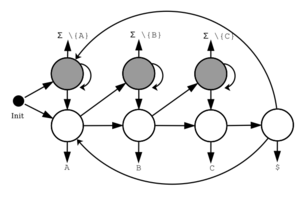
Learning Event Detection Rules with Noise Hidden Markov Models
We present a method, by which a domain expert can simply signal the occurrence of a significant incident at a specific point in time. The system then infers rules for automatically detecting such occurrences later on. At the core of our approach is an extension of hidden Markov models (HMM) called noise hidden Markov models (nHMM) that can be trained with existing, low-level event data. The nHMM can be applied online without any intervention of programming experts. An evaluation on both synthetic and real event data shows the efficiency of our approach even under the presence of highly frequent, insignificant events and uncertainty in the data.
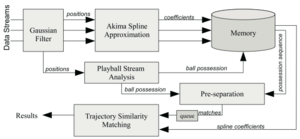
Online Data Stream Mining on Interactive Trajectories in Soccer Games
This paper proposes an online data mining method that is able to recognize repeating patterns of trajectory movements regardless of how they are scaled, rotated or translated. The result is an efficient data stream mining application, which provides meaningful information within the current game. The framework is designed in a modular manner in order to enhance the capabilities easily. The evaluation of the algorithms proves the efficiency of the provided concepts.
« First ‹ Previous 1 4 5 6