
Selected Publications




All Publications
‹ Previous 1 2 3 4 5 … 9 Next ›
Estimating Multipath Component Delays with Transformer Models
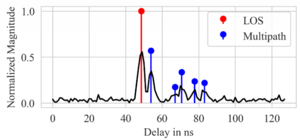
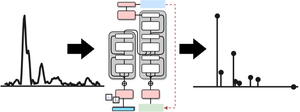
We implicitly estimate the number of MPCs and achieve subsample accuracy without using computationally intensive super-resolution techniques. Our approach outperforms known methods in detection performance and accuracy at different bandwidths. Our ablation study shows exceptional results on simulated and real datasets and generalizes to unknown radio environments.
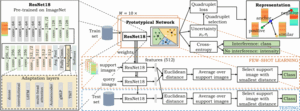
Few-shot learning with uncertainty-based quadruplet selection for interference classification in GNSS data
We propose a few-shot learning (FSL) approach to adapt to new interference classes. Our method employs quadruplet selection for the model to learn representations using various positive and negative interference classes. Furthermore, our quadruplet vari-ant selects pairs based on the aleatoric and epistemic uncertainty to differentiate between similar classes. We recorded a dataset at a motorway with eight interference classes on which our FSL method with quadruplet loss outperforms other FSL techniques in jammer classification accuracy with 97.66%. https://gitlab.cc-asp.fraunhofer.de/darcy_gnsslFIOT_highway.
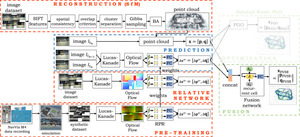
Fusing Structure from Motion and Simulation-augmented Pose Regression from Optical Flow for Challenging Indoor Environments
We enhance the performance of SfM and PoseNet in retrieving absolute poses, evaluate PGO to optimize the absolute pose and conduct a benchmark of 25 convolutional, recurrent, and Transformer networks in absolute and relative pose fusion.
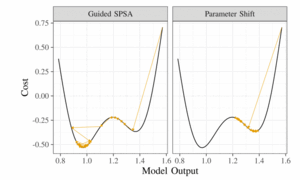
Guided-SPSA: Simultaneous Perturbation Stochastic Approximation assisted by the Parameter Shift Rule
We introduce a novel gradient estimation approach called Guided-SPSA, which meaningfully combines the parameter-shift rule and SPSA-based gradient approximation. We demonstrate numerically the performance of Guided-SPSA on different paradigms of quantum machine learning, such as regression, classification, and reinforcement learning.
Improving quantum and classical decomposition methods for vehicle routing
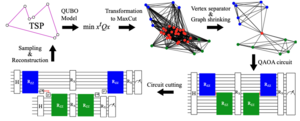
We demonstrate the utility of our novel shrinking method by successfully applying it to the archetypical traveling salesperson problem (TSP) which often occurs as a sub-problem in practically relevant vehicle routing applications. For a TSP with seven cities, we are able to retrieve an optimum solution by consecutively running two 7-qubit QAOA circuits. Without decomposition methods, we would require five times as many qubits. Our results offer insights into the performance of algorithms for combinatorial optimization problems within the constraints of current quantum technology.
Offsite evaluation of localization systems: criteria, systems and results from IPIN 2021-22 competitions
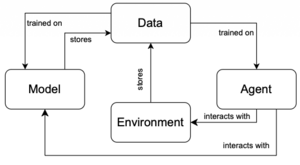
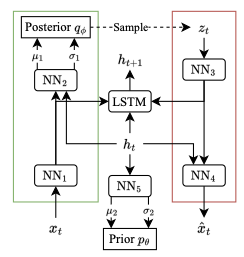
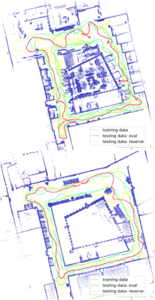
The main contribution of this work is to show a compilation of possible indoor positioning scenarios and different indoor positioning solutions to the same problem.
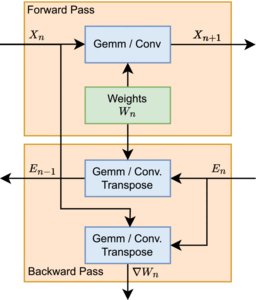
On-Device Training of Fully Quantized Deep Neural Networks on Cortex-M Microcontrollers
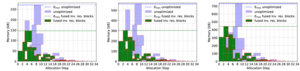
We present a method that enables efficient training of DNNs completely in place on the MCU using fully quantized training (FQT) and dynamic partial gradient updates. We demonstrate the feasibility of our approach on multiple vision and time-series datasets and provide insights into the tradeoff between training accuracy, memory overhead, energy, and latency on real hardware. The results show that compared to related work, our approach requires 34.8% less memory and has a 49.0% lower latency per training sample, with dynamic partial gradient updates allowing a speedup of up to 8.7 compared to fully updating all weights.
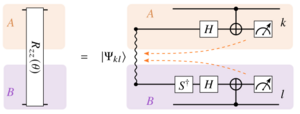
Optimal Joint Cutting of Two-qubit Rotation Gates
Circuit cutting, the partitioning of quantum circuits into smaller independent fragments, has become a promising avenue for scaling up current quantum-computing experiments. Here, we introduce a scheme for joint cutting of two-qubit rotation gates based on a virtual gate-teleportation protocol. With that, we significantly lower the previous upper bounds on the sampling overhead and prove the optimality of the scheme. Furthermore, we show that no classical communication between the circuit partitions is required. For parallel two-qubit rotation gates we derive an optimal ancilla-free decomposition, which includes cnot gates as a special case.
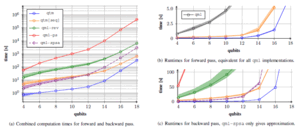
Qiskit-torch-module: Fast prototyping of quantum neural networks
We develop the qiskit-torch-module, building on the widely used Qiskit software environment. It improves runtime performance by two orders of magnitude over comparable libraries, while facilitating low-overhead integration with existing code-bases. Moreover, the framework provides advanced tools for integrating quantum neural networks with PyTorch. The pipeline is tailored for single-machine compute systems, which constitute a widely employed setup in day-to-day research efforts.
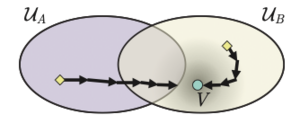
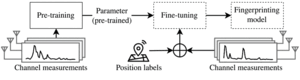
Radio Foundation Models: Pre-training Transformers for 5G-based Indoor Localization
We propose a self-supervised learning framework that pre-trains a general transformer (TF) neural network on 5G channel measurements that we collect on-the-fly without expensive equipment. Our novel pretext task randomly masks and drops input information to learn to reconstruct it. So, it implicitly learns the spatiotemporal patterns and information of the propagation environment that enable FP-based localization. Most interestingly, when we optimize this pre-trained model for localization in a given environment, it achieves the accuracy of state-of-the-art methods but requires ten times less reference data and significantly reduces the time from training to operation.