Selected Publications




All Publications
‹ Previous 1 2 3 4 5 6 … 9 Next ›
Reinforcement Learning for Node Selection in Branch-and-Bound
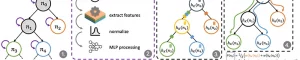
We train a graph neural network that produces a probability distribution based on the path from the model’s root to its “to-be-selected” leaves. Representing node-selection as a probability distribution allows us to train a decision-making policy using state-of-the-art RL techniques that capture both intrinsic node-quality and node-evaluation costs.
Our method induces a high quality node selection policy on a set of varied and complex problem sets, despite only being trained on specially designed, synthetic travelling salesmen problem (TSP) instances.
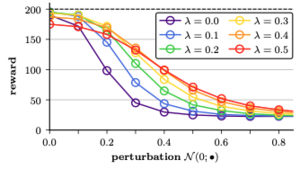
Robustness and generalization in quantum reinforcement learning via lipschitz regularization
This paper addresses the robustness and generalization of quantum reinforcement learning by combining principles from quantum computing and control theory. Leveraging recent results on robust quantum machine learning, we utilize Lipschitz bounds to propose a regularized version of a quantum policy gradient approach, named the RegQPG algorithm. We show that training with RegQPG improves the robustness and generalization of the resulting policies. Furthermore, we introduce an algorithmic variant that incorporates curriculum learning, which minimizes failures during training. Our findings are validated through numerical experiments, demonstrating the practical benefits of our approach.
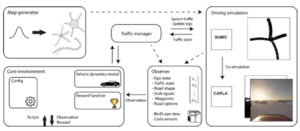
SCIM MILQ: An HPC Quantum Scheduler
SCIM MILQ is a scheduler for quantum tasks in HPC infrastructure. It combines well-established scheduling techniques with methods unique to quantum computing, such as circuit cutting. SCIM MILQ can schedule tasks while minimizing the makespan, i.e., the time that elapses from the start of work to the end, improving on average by 25 %. Additionally, it reduces the noise in the circuit by up to 10 %, increasing the outcome’s reliability. We compare it against an existing baseline and show its viability in an HPC environment.
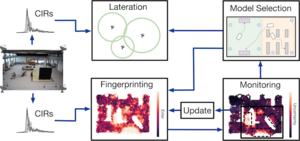
Uncertainty-based fingerprinting model monitoring for radio localization
In this article, we propose methods for uncertainty estimation of AI-based fingerprinting to determine its spatial boundaries and validity. Our experiments show that we can successfully identify spatial boundaries of the fingerprinting models and detect corrupted areas. In contrast to the state-of-the-art, our approach employs an intrinsic identification through out-of-distribution (OOD) detection, rendering external detection approaches unnecessary.
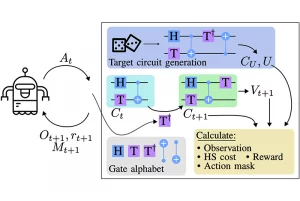
Unitary Synthesis of Clifford+T Circuits with Reinforcement Learning
In this study, we apply the tree-search method Gumbel AlphaZero to solve the problem for a subset of exactly synthesizable Clifford+T unitaries. Our method effectively synthesizes circuits for up to five qubits generated from randomized circuits with up to 60 gates, outperforming existing tools like QuantumCircuitOpt and MIN-T-SYNTH in terms of synthesis time for larger qubit counts. Furthermore, it surpasses Synthetiq in successfully synthesizing random, exactly synthesizable unitaries. These results establish a strong baseline for future unitary synthesis algorithms.

Unlocking Artificial Intelligence: From Theory to Applications
This open access book provides a state-of-the-art overview of current machine learning research and its exploitation in various application areas. It has become apparent that the deep integration of artificial intelligence (AI) methods in products and services is essential for companies to stay competitive. The use of AI allows large volumes of data to be analyzed, patterns and trends to be identified, and well-founded decisions to be made on an informative basis. It also enables the optimization of workflows, the automation of processes and the development of new services, thus creating potential for new business models and significant competitive advantages.
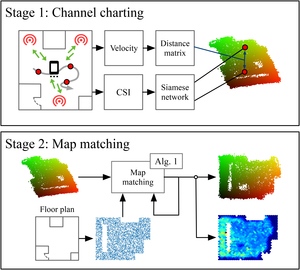
Velocity-based Channel Charting with Spatial Distribution Map Matching
We propose a novel channel charting framework that does not require references and dramatically reduces life-cycle management. With velocity information, e.g., pedestrian dead reckoning or odometry, we model relative charts. And with topological map information, e.g., building floor plans, we transform them into real coordinates. In a large-scale study, we acquired two realistic datasets using 5G and single-input and multiple-output distributed radio systems with noisy velocities and coarse map information. Our experiments show that we achieve the localization accuracy of FP but without reference information.
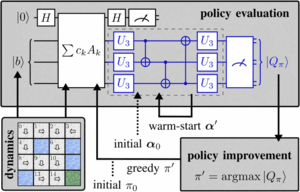
Warm-start variational quantum policy iteration
We propose the variational quantum policy iteration (VarQPI) algorithm, realizing this step with a NISQ-compatible quantum-enhanced subroutine. Its scalability is supported by an analysis of the structure of generic reinforcement learning environments’ laying the foundation for potential quantum advantage with utility-scale quantum computers. Furthermore, we introduce the warm-start initialization variant (WS-VarQPI) that significantly reduces resource overhead. The algorithm solves a large FrozenLake environment with an underlying 256×256-dimensional linear system, indicating its practical robustness.
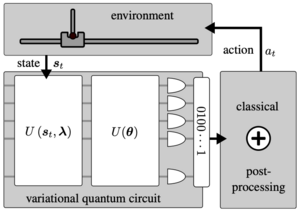
Quantum Policy Gradient Algorithm with Optimized Action Decoding
Quantum machine learning implemented by variational quantum circuits (VQCs) is considered a promising concept for the noisy intermediate-scale quantum computing era. Focusing on applications in quantum reinforcement learning, we propose an action decoding procedure for a quantum policy gradient approach. We introduce a quality measure that enables us to optimize the classical post-processing required for action selection, inspired by local and global quantum measurements. The resulting algorithm demonstrates a significant performance improvement in several benchmark environments.
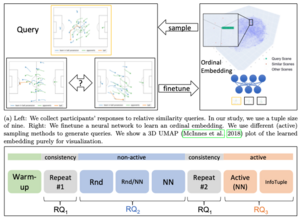
Active Learning of Ordinal Embeddings: A User Study on Football Data
We adapt an entropy-based active learning method with recent work from triplet mining to collect easy-to-answer but still informative annotations from human participants and use them to train a deep convolutional network that generalizes to unseen samples.
Our user study shows that our approach improves the quality of the information retrieval compared to a previous deep metric learning approach that relies on a Siamese network. Specifically, we shed light on the strengths and weaknesses of passive sampling heuristics and active learners alike by analyzing the participants’ response efficacy. To this end, we collect accuracy, algorithmic time complexity, the participants’ fatigue and time-to-response, qualitative self-assessment and statements, as well as the effects of mixed-expertise annotators and their consistency on model performance and transfer-learning.
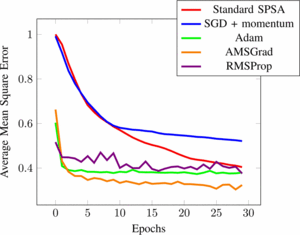
An Empirical Comparison of Optimizers for Quantum Machine Learning with SPSA-based Gradients
We introduce a novel approach that uses the approximated gradient from SPSA in combination with state-of-the-art gradient-based classical optimizers. We demonstrate numerically that this out-performs both standard SPSA and the parameter-shift rule in terms of convergence rate and absolute error in simple regression tasks. The improvement of our novel approach over SPSA with stochastic gradient descent (SGD) is even amplified when shot- and hardware-noise are taken into account. We also demonstrate that error mitigation does not significantly affect our results.
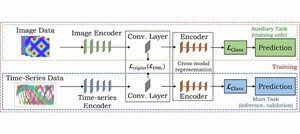
Auxiliary Cross-Modal Representation Learning with Triplet Loss Functions for Online Handwriting Recognition
We present a triplet loss with a dynamic margin for single label and sequence-to-sequence classification tasks. We perform extensive evaluations on synthetic image and time-series data, and on data for offline handwriting recognition (HWR) and on online HWR from sensor-enhanced pens for classifying written words. Our experiments show an improved classification accuracy, faster convergence, and better generalizability due to an improved cross-modal representation. Furthermore, the more suitable generalizability leads to a better adaptability between writers for online HWR.
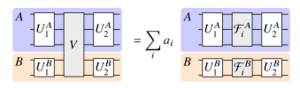
Cutting Multi-Control Quantum Gates with ZX Calculus
Circuit cutting, the decomposition of a quantum circuit into independent partitions, has become a promising avenue towards experiments with larger quantum circuits in the noisy-intermediate scale quantum (NISQ) era. While previous work focused on cutting qubit wires or two-qubit gates, in this work we introduce a method for cutting multi-controlled Z gates. We construct a decomposition and prove the upper bound O(6^2K) on the associated sampling overhead, where K is the number of cuts in the circuit. This bound is independent of the number of control qubits but can be further reduced to O(4.5^2K) for the special case of CCZ gates. Furthermore, we evaluate our proposal on IBM hardware and experimentally show noise resilience due to the strong reduction of CNOT gates in the cut circuits.